Atmospherical Precipitation
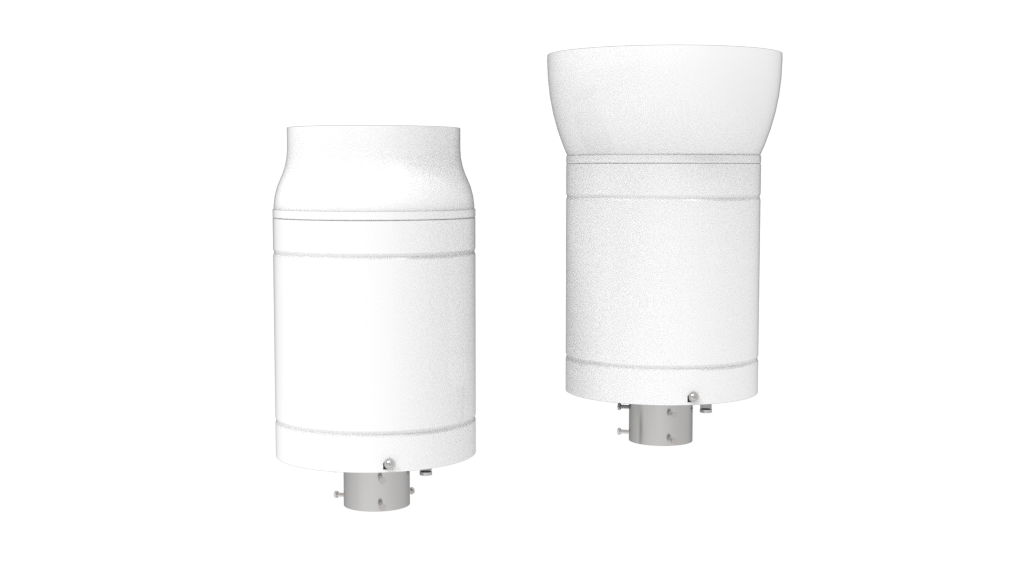
t043 TP500/TP1000
Precipitation transducer, collecting area 500/1000 cm²
TP rain gauges are high-precision sensors designed to measure cumulative precipitation and precipitation intensity. The measurement principle is based on a tipping bucket mechanism designed to minimize friction generated by the oscillating action. This system has made it possible to achieve high standards of accuracy across the entire measurement range. The sensor is available in both a contact/pulse output version (TP500-N and TP1000-N) and a version with correction electronics (TP500-E and TP1000-E) to compensate for the mechanical error intrinsically caused by the tipping
bucket operation, ensuring high accuracy even at high precipitation intensities. In particular, through numerous laboratory tests, an algorithm has been developed that allows the measured cumulative precipitation value to be modified, aligning it with the theoretical value according to the intensity of the rain. The sensor body is made of aluminum alloy and finally heat-coated with a special anti-UV paint that guarantees high durability and resistance to atmospheric agents. All available models are supplied with a power and signal cable (12 m).
 Technical specification
 Information request
t027 TP200
Precipitation transducer, collecting area 200 cm²
The TP200 is a rain gauge with a collection area of 200 cm2 and a tilting pan. It is extremely accurate and also suitable for latitudes where high intensity rainfall is the norm (monsoons or tropical rains). The sensor consists of an oscillating tipping bucket whose fulcrum, shaped like a knife blade, rests on a V-shaped seat in order to minimize friction, thus facilitating the tipping of the bucket and ensuring high accuracy even at high precipitation intensities. The sensor body is made of aluminum alloy and is hot-coated with a special UV-resistant paint that guarantees high durability and resistance to atmospheric agents. The TP200 is available in two versions: the TP200-N with pulse output without any type of signal conditioning, and the TP200-E equipped with signal conditioning electronics that reduce measurement uncertainties at high precipitation intensities, both for intensity and cumulative values. The TP200-E version provides contact output (cumulative precipitation), current output (cumulative precipitation), or Modbus and SDI-12 serial output (both intensity and cumulative) on a single connector.
The sensor in the TP200-N version only is also available with the option of a heater powered by 24 V DC or AC, and is supplied complete with power and signal cable (12 m).

t041-TPW
Weighing rain and snow gauge
The TPW series weighing gauge is designed to measure different types of atmospheric precipitation by measuring the weight of the precipitation itself. Whether it is rain, snow, or mixed, it precisely measures the precipitation weight defining both its amount and intesity. The weighing system is protected by an enclosure in order to make the measurement not be influenced by the external environment. Furthermore, the integrated circuit board of the instrument can manage both self-diagnostic operations and processing for the correction of measurement errors due to vibrations caused by wind, dust in the air, temperature fluctuations and other parameters.

t041-TPWE
Self-Emptying precipitation gauge
The TPWE series weighing gauge is designed to measure different types of atmospheric precipitation by measuring the weight of the precipitation itself. Whether it is rain, snow, or mixed, it precisely measures the precipitation weight defining both its amount and intensity. The TPWE is equipped with a special self-emptying mechanism making possible measurement of precipitation which is not limited by the bucket capacity. Once the bucket is almost full it tips and the water flows out through the outlet in the base plate. The emptying occurs fully automatically thanks to the special shape of the bucket. The process is very quick (less than one second) and therefore it doesn’t affect the measurement.
The weighing system is protected by an enclosure in order to make the measurement not be influenced by the external environment.
Furthermore, the integrated circuit board of the instrument can manage both self-diagnostic operations and processing for the correction of measurement errors due to vibrations caused by wind, dust in the air, temperature fluctuations and other parameters.
Show more measuring systems